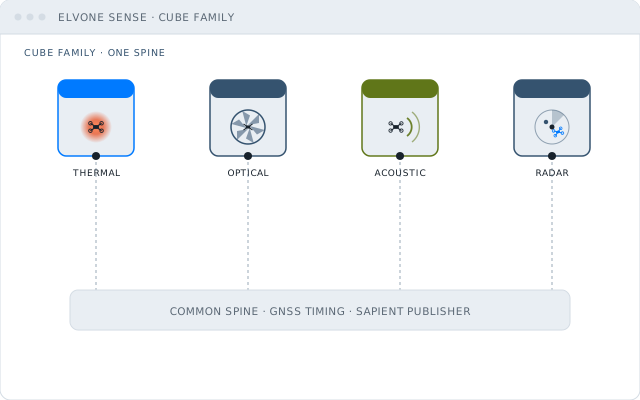
Sense is the deeper cube family for the gaps Cue and a site's existing sensors still can't cover. Each cube has its own physics, publishes to the same spine, and is added only where the threat and terrain demand it.
لكل ثغرة، مكعب استشعار“For every gap, a sensing cube.”
Thermal
Heat-signature confirmation, day or night, at classification-grade range.

Optical
Visual confirmation for an operator before an evidence file closes.
Acoustic
Rotor and engine signatures, including small, quiet platforms.
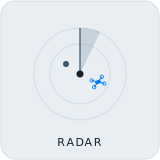
Radar
All-weather tracking, extending to fully RF-silent coverage.
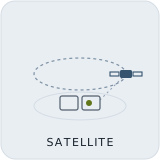
Satellite · the regional layer
Regional cues between passes: launch-site and staging changes, not real-time flight, via elvone Watch on Core.
This isn't a Sense cube on the common spine: it's a slower, complementary satellite layer, delivered as elvone Watch on Core. No satellite detects a small drone in flight; this flags what changed on the ground between passes.
Engineering rules
What makes it a platform, not a pile of sensors
Every Sense cube obeys the same design rules elvone Core is built around. Four of the eight are what matter most for how the cube family behaves in the field.
Rule 1
Publish detections, not data
A detection is a few hundred bytes: time, bearing or position, covariance, descriptor. No raw video, audio or IQ crosses the network.
Rule 2
Physics stated, not assumed
Every cube ships with a sensor equation and a propagation model. Performance is a detection probability against a measured signal-to-clutter figure, for a named target size, at a stated range.
Rule 3
Classical where the model is known
Point detection, temporal integration and beamforming are classical and analysable. Learning is reserved for clutter suppression and track classification.
Rule 4
Heterogeneous coincidence
Two cubes of different physics agreeing in bearing and time is the discriminator that lowers false alarms, not a single sensor voting alone.
What we claim, and how it's measured
A worked example: the thermal cube
Policy: no range figure is published without the target size, range, background and clutter class it was measured against. A figure is a target until the named test is complete.
A 0.35 m quadcopter with 10 K intrinsic contrast, viewed by a 24 mm uncooled LWIR core (500 µrad IFOV, 40 mK NETD), gives a single-frame signal-to-noise ratio of roughly 8 at 2 km under an ideal uniform background, rising to roughly 40 with 30-frame integration.
The binding term in practice is residual fixed-pattern noise after background subtraction, not sensor NETD, so the honest number is the one measured after that correction, not the datasheet figure. A sim-to-real gate applies: measured signal-to-noise on RTK-truthed flight data must agree with the simulated figure within tolerance before any simulation-derived number is used in a customer-facing claim.
Rule 7 · One spine, many fronts
Every cube in the Sense family shares the same enclosure family, GNSS-disciplined timing, solar or battery power, radio link, health telemetry and signed A/B OTA path. That shared spine is what makes local assembly practical, and what keeps a four-cube site behaving like one instrument instead of four.